
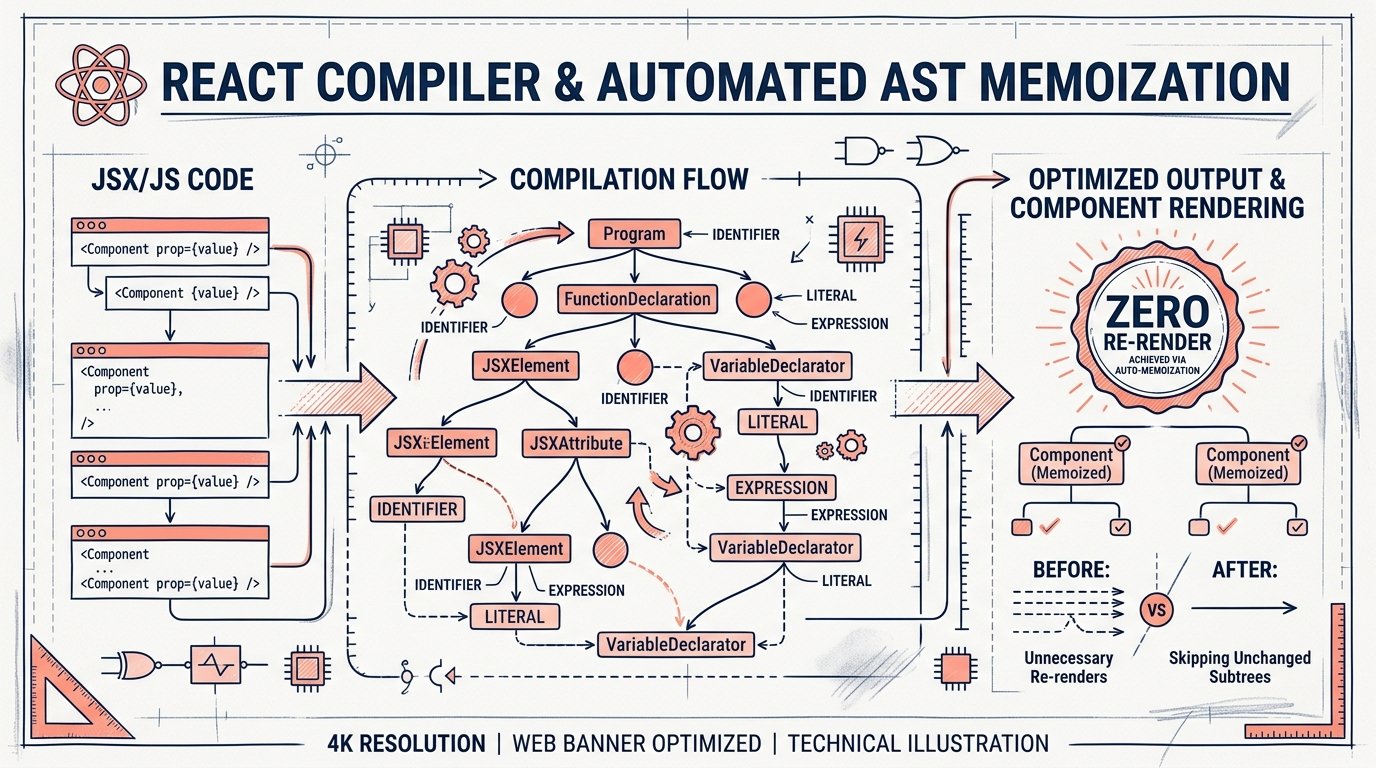
For nearly a decade, React developers had to manually orchestrate performance optimizations using useMemo, useCallback, and React.memo. With the arrival of React Compiler (formerly known as React Forget), automatic memoization transforms how we write performant React applications.
1. The Mental Overhead of Manual Memoization
Pehle ke codebases me, har state change pe child components re-render hote the. To fix this, developers wrapped every handler in useCallback and every derived value in useMemo. But this created two severe issues:
- Dependency Array Bugs: Missing a dependency caused stale closures, while over-specifying dependencies defeated memoization entirely.
- Code Clutter & Cognitive Load: 30% of typical component boilerplate was dedicated strictly to performance workarounds rather than domain logic.
Jab React Compiler build step me run hota hai, it performs deep Static Single Assignment (SSA) analysis on JavaScript ASTs to automatically insert granular memoization blocks at compile-time.
// ❌ Legacy Manual Approach
function UserDashboard({ user, orders, filterCriteria }) {
  const filteredOrders = useMemo(() => {
    return orders.filter(o => o.status === filterCriteria);
  }, [orders, filterCriteria]);

  const handleSelect = useCallback((id) => {
    trackSelection(user.id, id);
  }, [user.id]);

  return <OrderGrid list={filteredOrders} onSelect={handleSelect} />;
}

// ✅ Modern React Compiler Code (Pure, Idiomatic React)
function UserDashboard({ user, orders, filterCriteria }) {
  // React Compiler automatically memoizes filteredOrders and onSelect!
  const filteredOrders = orders.filter(o => o.status === filterCriteria);
  const handleSelect = (id) => trackSelection(user.id, id);

  return <OrderGrid list={filteredOrders} onSelect={handleSelect} />;
}
2. How the Compiler Analyzes Rules of React
The compiler enforces strict adherence to the Rules of React. It verifies that component rendering is pure, props and state are immutable, and side effects remain strictly confined to useEffect or event handlers.
Agar kisi component me rule violations hote hain (like mutating a prop during render), the compiler gracefully skips auto-memoization for only that specific component without breaking your application build.
3. Production Benchmarks & Rollout Strategy
In large enterprise applications, enabling React Compiler produces noticeable performance gains:
- Interaction to Next Paint (INP): Re-render CPU time reduced by 40–60% during complex state updates.
- Bundle Size: Eliminating manual memoization imports slightly trims down runtime complexity.
- Developer Velocity: Engineers write simpler, cleaner component logic without debating dependency arrays in code reviews.
useMemo and useCallback unless you are managing non-React external subscriptions. Let the React Compiler handle granular dependency tracking at build time.