
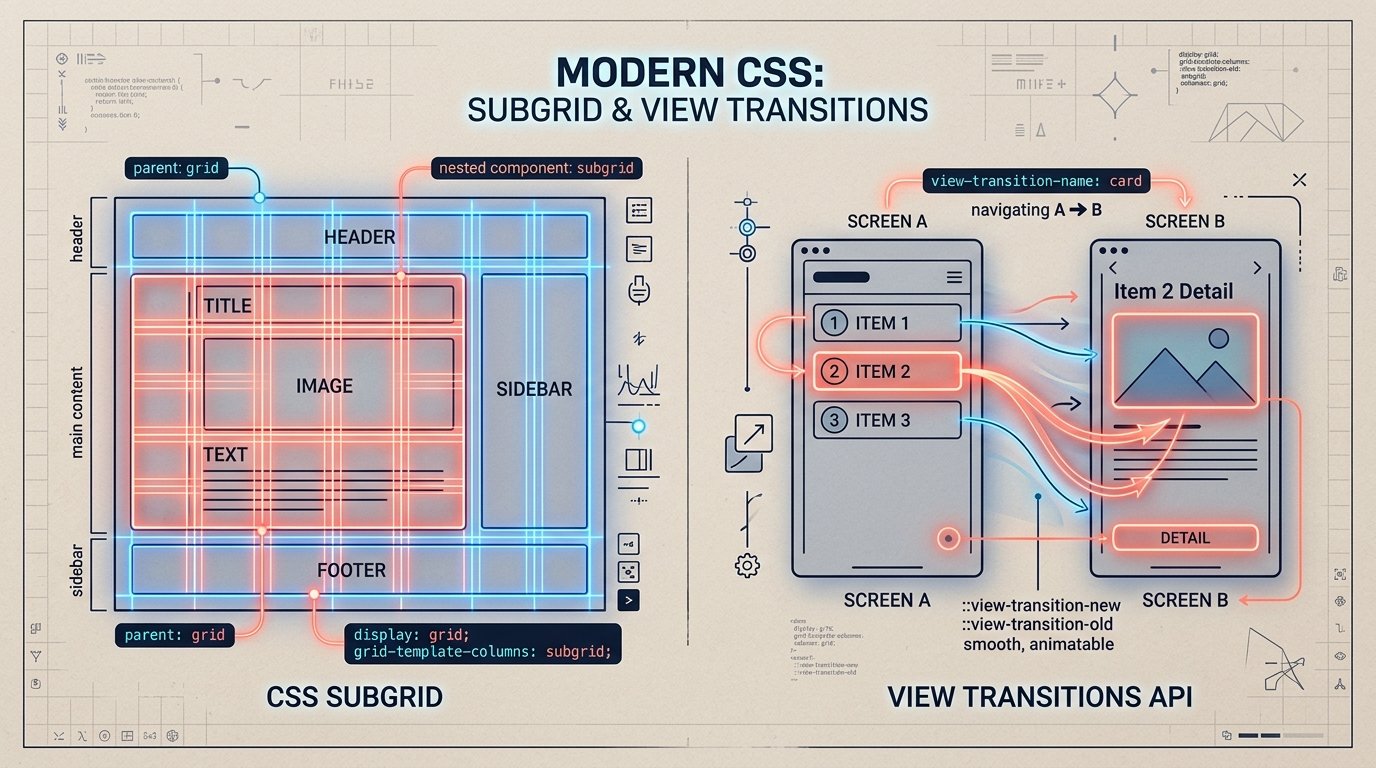
The landscape of modern web design has fundamentally transformed. Features that once required bloated JavaScript layout engines, resize observers, and heavy animation libraries can now be built natively with pure, hardware-accelerated CSS.
1. True Nested Grid Alignment with CSS Subgrid
For years, creating complex card grids where titles, badges, descriptions, and buttons lined up horizontally across cards required arbitrary min-heights or complex flexbox hacks. Jab multiple cards mein content length different hoti thi, tab layout sambhalna mushkil ho jata tha. CSS Subgrid solves this natively:
.card-grid {
  display: grid;
  grid-template-columns: repeat(auto-fit, minmax(320px, 1fr));
  gap: 24px;
}

.card {
  display: grid;
  grid-template-rows: subgrid;
  grid-row: span 4; /* header, badge, body, footer */
}
With grid-template-rows: subgrid, child cards participate in the parent grid's track sizing directly. Regardless of differing content lengths, every button and header aligns perfectly without a single line of JavaScript.
2. The Relational :has() Selector (The "Parent Selector")
The :has() pseudo-class allows developers to style parent elements or preceding siblings based on descendant states. This turns CSS into a reactive styling engine:
/* Style card differently when containing a featured badge */
.card:has(.badge-featured) {
  border-color: var(--color-accent);
  box-shadow: 8px 8px 0px var(--color-border);
}

/* Darken page backdrop when modal is open */
body:has(dialog[open]) {
  overflow: hidden;
}
3. Fluid Native Page Transitions with the View Transitions API
Single-page apps (SPAs) previously held a monopoly on fluid page-to-page transitions. Ab bina heavy client-side routers ke, the native View Transitions API brings seamless morphing animations to multi-page websites:
@view-transition {
  navigation: auto;
}

.hero-img {
  view-transition-name: hero-portrait;
}